
Nobody wants to make a major HVAC decision when they're sweating through a heat wave or bundled up in blankets because the furnace quit. But that's usually when the question hits: do I fix this thing again, or is it finally time to replace it?
There's no universal answer, and anyone who tells you otherwise is probably trying to sell you something. The right call depends on your system's age, its repair history, what's actually wrong with it, and what your home has been putting up with in terms of comfort and energy bills. What follows is a practical breakdown of how to think through that decision without the pressure of an emergency pushing you in the wrong direction.
Why 2026 Is a Good Year to Pay Attention
A lot of systems installed in the mid-2000s and early 2010s are hitting that 15-to-20-year mark right now. That doesn't mean they've automatically failed, but it does mean they're operating in a different era than the one they were designed for.
Efficiency standards have shifted. The SEER2 rating system gives homeowners a more current benchmark for comparing air conditioning and heat pump performance, and modern high-efficiency systems clear that bar by a significant margin over older equipment. If your current system was considered efficient when it was installed, that comparison may look a lot different today.
Technology has also moved. Variable-speed operation, smart thermostat integration, improved filtration, and quieter performance are all standard features on many new systems. That doesn't mean you should replace a working system to get them, but it does make replacement more appealing when the existing equipment is already struggling.
How Long Should an HVAC System Last?
Most central air conditioners and furnaces hold up well for 10 to 15 years. Some reach 15 to 20 with consistent maintenance. Heat pumps can wear faster because they handle both heating and cooling, often running for more of the year than a system dedicated to one season.
Maintenance history matters more than most people realize. A well-maintained 14-year-old system can outperform a neglected 8-year-old one. Before any repair or replacement conversation, we will look at the system's installation date, model number, and whatever service records you can find. Warranty status is worth checking too. That information gives your technician a much clearer picture of what the system is actually worth at this point.
When Repair Is the Right Move
If the system is relatively new and the problem is isolated, repair is usually the smarter call. A bad capacitor, a faulty thermostat, a clogged drain line, a dirty coil, a worn belt, none of those automatically mean the system is finished. They're parts problems, not system failures.
Repair also makes sense when energy bills have been steady, the home heats and cools evenly, airflow feels normal, and breakdowns have been rare. A single repair on a dependable system is just that, a repair.
Warranty coverage can tip the scales further. If the failed part is under a parts or labor warranty, the cost comparison between repair and replacement shifts considerably. Always ask about warranty status before assuming you're facing a full replacement.
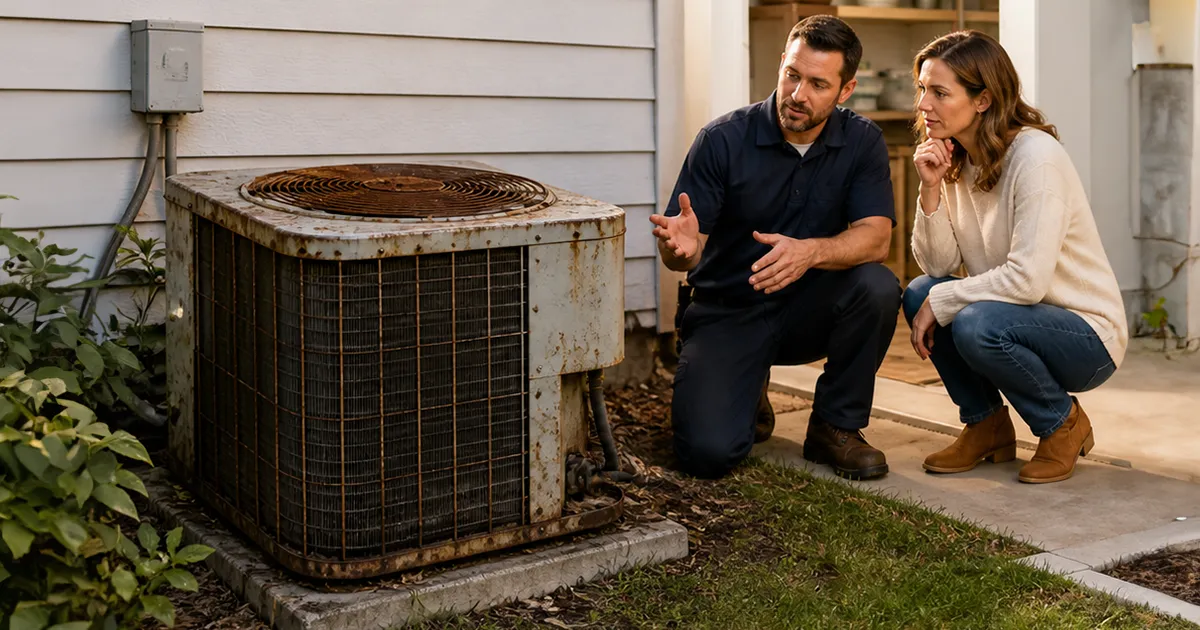
Someone from Wright's Air can lay out what went wrong, what the fix involves, and what it's likely to cost. If a straightforward repair will get a reliable system back up and running safely, replacement shouldn't be pushed as your only option.
Warning Signs It May Be Time to Replace
Some symptoms are easy to write off individually, but they tell a different story together.
Repeated repair calls are one of the clearest red flags. One repair might be fine. Multiple service calls in a single season usually mean parts are wearing down across the board, not just in one isolated spot. Each repair may buy a few more months, but the math starts working against you.
Rising energy bills can point to declining efficiency, especially when nothing else has changed in the home. A system that runs longer than it used to, cycles on and off constantly, or struggles to hit the thermostat setting is likely burning more energy to do less work.
Comfort problems deserve attention too. Hot or cold rooms, weak airflow, humidity that feels off, or air that's stuffy no matter what the thermostat says can come from aging equipment, duct issues, or a system that's no longer matched to the home's actual needs. None of those get better on their own.
Major component failures change the repair math significantly. A failed compressor, cracked heat exchanger, evaporator coil problem, or significant blower motor issue on an older system is expensive to fix. Putting that kind of money into equipment that's already near the end of its expected lifespan rarely makes financial sense.
Refrigerant type is worth mentioning for older air conditioning systems. If the system uses a refrigerant that's no longer widely produced, repairs can get complicated and expensive in ways that have nothing to do with the equipment itself.
The Cost Question
This is usually where the conversation really starts. The 50% rule is a common starting point: if a repair costs more than half the price of a new system, replacement is often the better investment. It's a rough guideline, not a formula, but it helps frame the decision.
A smarter way to think about it is to look at what you've already spent. Add up recent service calls, emergency fees, and any parts replaced over the past couple of years. A system that seemed cheaper to repair may look different once you total those costs up against what a replacement would have run.
Replacement costs vary based on system type, home size, efficiency level, ductwork condition, and installation requirements. It's more than just swapping out the equipment. We might need to evaluate electrical connections, refrigerant lines, drainage, airflow, and thermostat compatibility.
The timing also matters. Homeowners who plan ahead can compare options, ask about rebates and tax credits, and schedule installation on their terms instead of in the middle of a heat wave when availability and pricing may be different.
Comfort Problems Worth Taking Seriously
One bedroom that never cools off. A living room that stays stuffy. A furnace that runs all afternoon and still leaves part of the house cold. These are the complaints that often come before anyone even thinks about a technical failure, and they matter.
Uneven temperatures can come from several places: leaky ducts, poor insulation, blocked vents, aging equipment, or a system that was never properly sized for the home. A professional evaluation can separate a fixable airflow problem from a sign that the equipment has simply run out of capacity.
Weak airflow is worth checking yourself first. A dirty filter can restrict airflow significantly and costs almost nothing to fix. Check or replace the filter before assuming something more serious is going on.
Humidity issues are their own category. A home that feels sticky in summer may have an air conditioner that's short cycling, oversized, or losing its ability to remove moisture. A home that's dry in winter may need better system control or maintenance. Neither problem is comfortable to live with, and neither gets addressed by ignoring it.
Dust, odors, and allergy symptoms can also tie back to HVAC performance. Poor filtration, dirty components, or duct problems can all affect what's circulating through the air in your home.
What You Actually Gain From a New System
A new HVAC system isn't just a newer version of what you already have. The design has changed.
Variable-speed and two-stage systems run at lower levels for longer periods, which tends to keep temperatures more consistent without the burst-on, shut-off cycling that older single-stage systems are known for. That difference is noticeable in daily comfort, not just on paper.
Modern systems are also quieter, often dramatically so compared to equipment that's a decade or more old. Many support better filtration and humidity control, which can matter a lot for families dealing with allergies, pets, or air quality concerns.
For homeowners planning to sell, a newer system can strengthen the listing. Buyers do ask about the age of major home systems, and not having to budget for HVAC replacement after moving in is a legitimate selling point. For homeowners staying put, the bigger payoff is the day-to-day reliability of equipment that isn't always on the verge of the next breakdown.
Budgeting When You Know Replacement Is Coming
Higher-efficiency systems cost more upfront. They can also reduce energy use over time. Whether that tradeoff makes sense depends on how long you plan to stay in the home, what your current utility bills look like, and what comfort improvements you're hoping to achieve.
Rebates, tax credits, financing, and manufacturer promotions can change what replacement actually costs you. These options shift over time, so it's worth asking us what's currently available before deciding on equipment.
Planning ahead gives you the most control. You can compare options, schedule installation at a time that works for your schedule, and avoid paying emergency pricing when a system fails at the peak of summer or in the dead of winter.

Final Thoughts
A minor issue on a newer, reliable system is usually a repair. Frequent breakdowns, climbing energy bills, uneven comfort, and an older system that's already had a rough few years usually point toward replacement.
The best way to remove the guesswork is a professional inspection. One of our technicians can evaluate the full condition of your system, explain what they found, and give you real options for both repair and replacement is the one worth trusting. Give us a call at (903) 455-5662 to schedule your appointment before the heat kicks in!